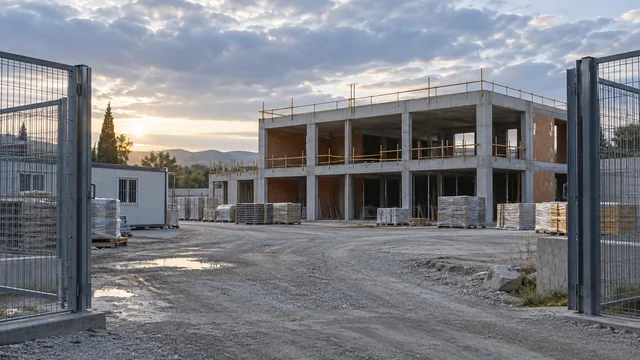
A contractor no longer turns up on site, no longer answers meeting notices and has taken away its equipment. For the client on a project (an investor, a building owner, a developer or a business building for its own use), the temptation is to call in another contractor straight away. That is the mistake to avoid: the first contractor’s contract is still in force, and nothing yet establishes what it has actually built.
This guide sets out the order of decisions on a private works contract under French law, on the site side and the contract side, with the legal texts as read on Légifrance on 13 November 2026. It does not replace a lawyer: formal notices and termination notices are drafted with your lawyer.
Download: Restarting a stalled site: the method (PDF, 6 pages, in French).
How do you recognise site abandonment?
Site abandonment is when a contractor stops performing its contract without valid reason and does not resume despite written requests. Absence alone does not prove it: you need dated facts, and you must first rule out stoppages that the law or the contract allows.
The French Civil Code articles cited in this guide do not use the expression “site abandonment” (abandon de chantier): they speak of non-performance. That is what has to be proved.
The facts that prove it
- no workers or supervisors on site, across several dated site records;
- equipment, scaffolding or site welfare facilities removed without agreement;
- repeated absence from site meetings, recorded in the site minutes;
- letters and emails left unanswered;
- orders cancelled, subcontractors saying they have not been paid.
What is not abandonment
- The unpaid contractor. Under French law, where the client owes a payment guarantee and has not provided it, a contractor left unpaid for work carried out “may suspend performance of the contract after a formal notice that has remained without effect for fifteen days” (Article 1799-1 of the Civil Code). More generally, a party may refuse to perform its obligation “if the other party does not perform its own and if that non-performance is sufficiently serious” (Article 1219 of the Civil Code). First check that its interim valuations have been paid.
- A justified or agreed stoppage. A stoppage requested by the lead consultant, an area not handed over by another trade package, a drawing awaiting approval: the contractor is not performing, but it is not at fault.
- Bad weather and force majeure. The contract usually sets out how bad-weather days are counted. Force majeure, on the other hand, is defined by French law: an event “beyond the debtor’s control” that could not reasonably have been foreseen when the contract was signed and whose effects cannot be avoided by appropriate measures (Article 1218 of the Civil Code). If the impediment is temporary, performance is only suspended.
In short: abandonment is proved by dated facts, not by an impression. Before accusing the contractor of it, check three things: that it has been paid, that no stoppage was requested or agreed, and that the contract does not give it bad-weather days for the period.
What should you do in the first days?
Four actions are taken in the first week: secure the site, have progress recorded jointly with the contractor, hold payments at the level of the work actually done, and notify insurers and guarantors. None of them ends the contract; all of them build the evidence.
- Secure the site. Close off access, protect work exposed to water, check the collective safety protection. These interventions stay limited and are recorded: they must not alter what is still to be recorded.
- Have progress recorded jointly. The contractor is invited in writing to a site visit. The record describes, area by area, what is finished, started, defective or only delivered to site, with dated photographs. If the contractor does not come, the invitation proves that it was invited.
- Hold payments at the level of what has been done. Each interim valuation is checked against the recorded progress. What has been built and checked is paid; nothing is paid beyond that. See our guide Payment certificates: what to check on a private contract.
- Notify insurers and guarantors. Your building damage insurance (dommages-ouvrage) insurer; the site insurer, if a policy was taken out; the institution that issued a guarantee: each contract sets its own deadlines and forms of notification.
At the same time, gather the documents for the trade package: contract, amendments, site instructions, valuations and payments, site minutes, insurance certificates, list of subcontractors.
Do you need a judicial officer’s report?
None of the texts cited here requires one, but it is hard to do without when the contractor does not attend the joint visit. The judicial officer (commissaire de justice, the new name for the French bailiff) records what they see on a given date. They do not say whether the work complies: the technical record remains the job of the lead consultant.
If the condition of the work is disputed or defects are suspected, an expert assessment can be requested from the court before any proceedings: under French law, “if there is a legitimate reason to preserve or establish, before any trial, evidence of facts on which the resolution of a dispute may depend”, investigative measures may be ordered “on application or in summary proceedings” (Article 145 of the Code of Civil Procedure). Where the measure concerns a building, only the court for the place where the building is located has jurisdiction.
Can you withhold payments?
Yes, within a limit. The party towards whom an undertaking has not been performed may “refuse to perform or suspend performance of its own obligation” (Article 1217 of the Civil Code), provided the non-performance is “sufficiently serious” (Article 1219). Suspending payment for work not done is therefore allowed. Withholding the price of work that has been done and complies, on the other hand, exposes the client to being accused of non-performance in turn.
How do you serve formal notice on the contractor to resume?
The formal notice (mise en demeure) is a written demand that the contractor resume the works within a reasonable time, stating what will follow if it does not. Almost all of the client’s rights depend on it: termination of the contract, performance by a third party, damages, penalties, building damage insurance (dommages-ouvrage).
The articles cited here do not require a single form for a formal notice to resume works. In practice, it is sent by recorded delivery with acknowledgement of receipt or served by a judicial officer, so that the date of receipt can be proved.
What it must contain
- the facts recorded and their dates, with the formal record attached;
- the works to be resumed and the time allowed to do so;
- an express statement that, failing this, the client “will be entitled to terminate the contract”: this is a requirement of Article 1226 of the Civil Code;
- if the contract contains a termination clause, an express reference to that clause: the formal notice “only takes effect if it expressly mentions the termination clause” (Article 1225 of the Civil Code).
How much time should you give the contractor?
The French Civil Code does not set a number of days: it requires a “reasonable time”. The contract, however, may set one. Reread the contract’s special administrative conditions (cahier des clauses administratives particulières, CCAP). If they refer to the French standard NF P 03-001, the clauses of that standard apply. Choose the time limit with your lawyer.
What it triggers
- Damages: “unless the non-performance is definitive”, they are only due if the debtor has been given formal notice to perform within a reasonable time (Article 1231 of the Civil Code).
- The penalties provided for in the contract: “except in the case of definitive non-performance, the penalty is only incurred once the debtor has been given formal notice” (Article 1231-5 of the Civil Code).
- Termination of the contract, performance by another contractor and building damage insurance before practical completion, all described below.
In short: the formal notice describes the facts, sets a reasonable time to resume and expressly mentions termination of the contract, as well as the termination clause if there is one. Without it, in principle, neither termination by notice, nor penalties, nor building damage insurance can come into play.
How do you end the contract before bringing in another contractor?
Until the contract has ended, the trade package remains committed to the defaulting contractor. The French Civil Code offers three ways to end it: the contract’s termination clause, notice given by the client after formal notice, or a court decision. The second is at the client’s own risk.
The text: “Termination (résolution) results either from the application of a termination clause or, in the case of sufficiently serious non-performance, from a notice given by the creditor to the debtor or from a court decision” (Article 1224 of the Civil Code).
The contract’s termination clause
If the contract provides its own termination procedure, that is the one to follow, within its time limits and in its forms. The clause specifies the obligations whose non-performance leads to termination, and termination is subject to a formal notice that has gone unheeded, unless the contract provides otherwise (Article 1225).
Termination by notice
Without a clause, or alongside it, the client “may, at its own risk, terminate the contract by notice” (Article 1226). The text requires three stages:
- a formal notice to perform within a reasonable time, except in an emergency, expressly mentioning the risk of termination;
- the non-performance continuing at the end of that time;
- a notice of termination, giving “the reasons for it”.
The contractor may go to court at any time to contest it. The client “must then prove the seriousness of the non-performance”: that is what the formal record, the site minutes and the formal notice are for. Termination takes effect “on the date on which the debtor receives the notice” (Article 1229 of the Civil Code). The account that follows is prepared with your lawyer.
Termination by the court
Termination can always be sought in court (Article 1227 of the Civil Code). The court may record it or order it, order performance of the contract while granting the contractor more time, or award damages only (Article 1228 of the Civil Code).
Having another contractor do the work, at the first contractor’s expense
After formal notice, the client may also, “within a reasonable time and at a reasonable cost, have the obligation performed itself” and claim from the defaulting contractor “reimbursement of the sums incurred for that purpose”. It may also ask the court to order the contractor to advance the sums needed (Article 1222 of the Civil Code). The “reasonable cost” is justified by a tender and comparable bids.
The route not to confuse it with
Under French law, the client may terminate a lump-sum contract “at its sole discretion”, but “by compensating the contractor for all its expenses, all its work and everything it could have earned from the contract” (Article 1794 of the Civil Code). That is not the route for abandonment: state in writing that the contract is ended because of the contractor’s non-performance.
In short: no other contractor works on the trade package until the contract has ended with the proper formalities, or until the formal notice has opened the right to have the work done by a third party. Termination by notice is decided at the client’s own risk, and the client must be able to prove the seriousness of the non-performance.
What if the contractor is in safeguard, reorganisation or liquidation proceedings?
The rules change. Under French insolvency law, the contract does not end merely because proceedings have opened, and the formal notice is no longer addressed to the contractor alone: it goes to the court-appointed administrator or the liquidator. If it remains unanswered for more than a month, the contract is terminated automatically.
Before serving any formal notice, check the contractor’s status on bodacc.fr, the website of the French official gazette of civil and commercial notices (Bulletin officiel des annonces civiles et commerciales, BODACC).
- The contract continues. No termination can result “solely from the opening of safeguard proceedings” (sauvegarde), whatever the contract clause says (Article L622-13 of the Commercial Code). The same rule applies in judicial reorganisation (redressement judiciaire, Article L631-14 of the Commercial Code) and in judicial liquidation (liquidation judiciaire, Article L641-11-1 of the Commercial Code).
- The formal notice to take a position. The contract is terminated automatically after a formal notice to decide whether the contract will continue, addressed to the administrator or the liquidator and “left unanswered for more than one month”. The supervising judge (juge-commissaire) may set a shorter time limit or grant an extension of up to two months. If there is no administrator, ask your lawyer to whom it should be addressed.
- Proof of claim. Overpayments, penalties, the extra cost of completion: these sums must be lodged as claims within two months of publication of the judgment in the BODACC (Article R622-24 of the Commercial Code). A claim whose amount is not yet fixed is lodged “on the basis of an estimate” (Article L622-24 of the Commercial Code). Have the applicable deadline confirmed according to the date on which the proceedings opened.
This situation has its own guide, with the other deadlines to watch: Contractor in liquidation: how to regain control of the site.
How do you cost the remaining work and tender it to a replacement?
The remaining work is costed from the joint record, not from the balance of the contract. It separates the work to be kept, the work to be redone and the work still to be built. This file forms the basis of the tender and justifies the extra cost claimed from the defaulting contractor.
The tender is prepared while the formal notice periods are running; the replacement contract is signed once the first contract has ended. Four precautions:
- have the tendering contractors visit the site, and have them put in writing their reservations about the existing work;
- separate investigations, remedial work and new work in the tender documents, so that the bids are comparable;
- invite several contractors to bid, so that you can show the cost of completion is reasonable;
- have the selected contractor and its insurer state what they accept of the existing work.
The full method is set out in two guides: the site audit, for the state of the work and of the accounts, and the recovery plan for a stalled site, for the restart budget and schedule. PRIMOE carries out stalled site recoveries in Paris and Île-de-France, including a 15-home site taken over in Pantin (93) under a construction supervision (MOEX) appointment, now in progress: see our stalled site recovery service.
Who pays the extra cost, and which guarantees apply?
In law, the extra cost is borne by the defaulting contractor. In practice, the client pays it up front, then recovers it depending on the contractor’s solvency and the guarantees in the contract. Building damage insurance (dommages-ouvrage) does not fund completion: before practical completion, it only covers the repair of certain damage.
What the defaulting contractor owes
The client may “seek compensation for the consequences of the non-performance”, and damages can always be added to the other remedies (Article 1217). The debtor is ordered, where appropriate, to pay damages “either for non-performance of the obligation or for delay in performance”, except in cases of force majeure (Article 1231-1 of the Civil Code). The extra cost claimed is the difference between the actual cost of completion and what remained to be paid to the contractor. The delay penalties provided for in the contract are added according to its clauses: see our guide Construction delays: how to prove them and apply penalties.
The retention or the guarantee
Under French law, on a private works contract, interim payments “may be reduced by a retention of no more than 5 per cent of their amount”, replaced by a guarantee if the contractor provides one (Article 1 of Law No. 71-584 of 16 July 1971). Under that text, it secures performance of the works to deal with the snags noted at practical completion. Whether it can be used after abandonment should be checked with your lawyer.
Does building damage insurance apply?
Only in one case, and for a limited purpose. Under French law, this insurance (dommages-ouvrage) guarantees payment for repairing damage for which the builders are liable under Article 1792 of the Civil Code, in other words ten-year latent defects liability (décennale). In principle, it takes effect after the first year following practical completion. The text adds that it guarantees payment for the necessary repairs where, “before practical completion, after a formal notice that has remained unheeded, the contract for works entered into with the contractor is terminated for non-performance by the contractor of its obligations” (Article L242-1 of the Insurance Code).
Three conditions can be read in that sentence: a formal notice that has had no effect, a terminated contract, and a termination based on the contractor’s non-performance. The cover then applies to repairing damage of that kind, not to the work still to be done. The same article exempts from this insurance certain legal entities building a non-residential building for their own account: first check that the policy exists.
Practical completion and the guarantees that depend on it
Under French law, practical completion (réception) is “the act by which the client declares that it accepts the work, with or without reservations”. It takes place “either by agreement or, failing that, by court order”, and the one-year defects warranty runs from that date (Article 1792-6 of the Civil Code). The work left by the defaulting contractor has not been accepted. How it is to be accepted, and on what date, should be decided with your lawyer before the replacement contractor covers it up.
In short: the extra cost of completion is a claim against the defaulting contractor, to be proved by the formal record and by the replacement bids. The retention or the guarantee covers only a limited part of it. Before practical completion, building damage insurance only applies after formal notice and termination for non-performance.
Site abandonment: the steps in order
Steps 1 to 4 are taken in the first week; step 7 is prepared while the time limits of steps 5 and 6 are running.
Scroll the table sideways →
| Step | What you do | Why | Legal text |
|---|---|---|---|
| 1. Secure | Close off access, protect exposed work, record every intervention | Prevent damage being added to the abandonment | No specific text: contract documents and insurance policies |
| 2. Record | Invite the contractor, record progress area by area, have a judicial officer draw up a report | Separate what has been done from what remains; prove the non-performance | Code of Civil Procedure, Article 145, if an expert assessment is needed |
| 3. Hold payments | Pay for what has been built and checked, nothing beyond | Avoid paying for work not done | Civil Code, Articles 1217 and 1219 |
| 4. Notify insurers and guarantors | Report the situation as each contract requires | Preserve the guarantees | Insurance policies and guarantee deeds |
| 5. Serve formal notice | Require the contractor to resume within a reasonable time, mentioning termination | Open the right to termination, damages and penalties | Civil Code, Articles 1226, 1225, 1231 and 1231-5 |
| 6. End the contract | Apply the termination clause, give reasoned notice of termination or go to court | Free up the trade package before giving it to another contractor | Civil Code, Articles 1224 to 1229 |
| 7. Cost and tender | Establish the remaining work, invite several contractors to bid | Sign a replacement contract on a known scope, at a justified cost | Civil Code, Article 1222 |
| 8. Claim the extra cost | Draw up the account, claim the difference, call on the guarantees | Make the defaulting contractor bear the extra cost | Civil Code, Articles 1217 and 1231-1; Insurance Code, Article L242-1 |
If the contractor is subject to insolvency proceedings, steps 5 and 6 follow the Commercial Code rules described above.
Site abandonment: the questions clients ask
How long before you can call it site abandonment?
The French Civil Code articles read for this guide set no time period. They speak of non-performance and how serious it is. What counts is dated facts: no workers on site, equipment removed, meeting notices unanswered. Abandonment is confirmed when the formal notice to resume has no effect.
How long before you can bring in another contractor?
Under French law there is no single statutory time limit. You need time for a formal record, then for a formal notice allowing a “reasonable time”, then for the notice of termination, which takes effect when the contractor receives it. The contract may set its own time limits. If the contractor is in insolvency proceedings, the period is one month after the formal notice sent to the administrator or the liquidator.
Do you need a judicial officer’s report when a site is abandoned?
The law does not require one, but it is very useful: it records the state of the site at a date that cannot be disputed, before any other contractor steps in. It complements the lead consultant’s joint record without replacing it, because it describes what is visible and does not rule on whether the work complies.
Can you withhold payments from a contractor that has abandoned the site?
Yes, for work not carried out: the French Civil Code allows a party to suspend its own obligation when the other party does not perform its own and that non-performance is sufficiently serious. Work carried out that complies is still payable. So hold payments at the level of the recorded progress, and have the account drawn up with your lawyer.
Can you terminate the contract without going to court?
Yes. After a formal notice that has had no effect, the client may terminate the contract by a reasoned notice (Article 1226 of the French Civil Code). It does so at its own risk: the contractor may go to court, and the client must then prove the seriousness of the non-performance.
Does building damage insurance apply when a site is abandoned?
Before practical completion, in one case only: after a formal notice that has remained unheeded, when the contract is terminated because the contractor has failed to perform its obligations (Article L242-1 of the French Insurance Code). It then pays for repairing damage of a ten-year latent defects (décennale) nature. It does not fund the work still to be done.
Who pays the extra cost when the contractor has to be replaced?
The defaulting contractor is liable for it: the client can claim from it reimbursement of the sums incurred to have the works carried out, and compensation for the consequences of the non-performance. In practice, the client pays these sums up front. What it recovers depends on the contractor’s solvency, the guarantees in the contract and the quality of its evidence.
Where do you start if the contractor has just left the site?
With the facts: close the site, invite the contractor to a joint record of progress, have a judicial officer’s report drawn up, check the contractor’s status in the BODACC and send the contract to your lawyer.
The work is then shared between three parties. The lawyer drafts the formal notice and the notice of termination. Construction supervision (MOEX, maîtrise d’œuvre d’exécution) records progress, costs the remaining work, prepares the tender and resets the schedule. The client decides. This role is described on our pages stalled site recovery and construction supervision, and in our Delivery path. To tell us about a site: contact@primoe.fr.