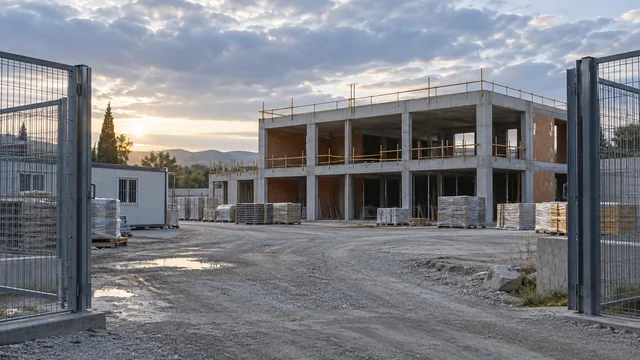
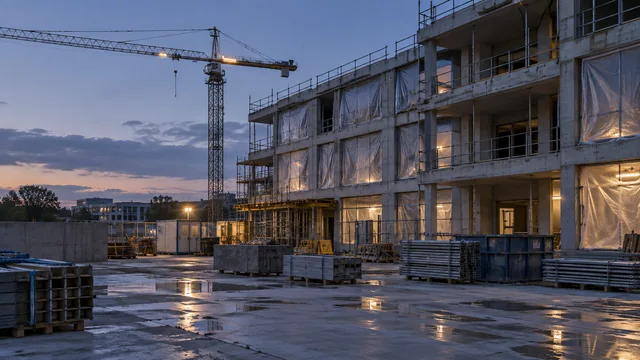
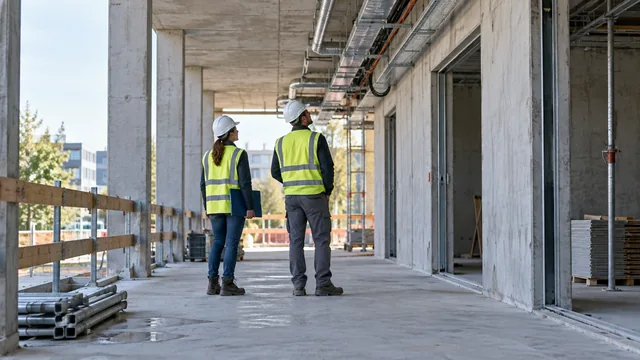
A site can stop even though the contracts are still live, the contractors are available or the funding seems secure. The blockage sometimes lies elsewhere: a design study is missing, a permit needs to be regularised, part of the works is causing a problem, or several decisions depend on one another. Rescheduling teams without removing that dependency often leads to a second stoppage.
For the client, the recovery plan must answer one specific question: what conditions allow each trade package to start again, then carry on to the next milestone? This approach ties administrative, technical and financial decisions to a usable schedule.
Downloadable version: Restarting a stalled site: the method (PDF, 6 pages, in French).
Stalled site: what should you decide in the first days?
In the first days after a site stops, five decisions are taken in order: secure the works, have their condition recorded in writing, notify insurers and guarantors, audit the remaining work, then rebuild the contractual framework. None of them restarts the works; all of them are conditions for the restart. The longer the stoppage lasts, the more each one costs.
- Physically secure the works. Make them weathertight as far as possible, fence them off, disconnect whatever needs disconnecting. An open floor plate exposed to the rain for months can turn a simple restart into an insurance claim.
- Have the condition of the existing works recorded in writing. A judicial officer’s report (constat de commissaire de justice), a dated photographic record, a survey of the work carried out, if possible with the contractors invited to attend: this record separates past liabilities from those of the recovery.
- Notify insurers and guarantors on time. Building damage insurance (dommages-ouvrage), completion guarantee (garantie de livraison), contract bonds: each contract sets its own notification deadlines. This work is done with your advisers, but it starts immediately.
- Audit before re-engaging. Without an audit of the remaining work, you end up paying full price for the first site’s problems. See our guide on site audits.
- Rebuild a contractual framework before restarting. Clear scopes between the existing works and the new, a binding schedule, enforceable penalties: the recovery is won or lost in the contracts.
This is the sequence followed by our stalled site recovery service: we step in from the first days to protect the works and fix the facts, not to restart the works.
What is really holding up the site?
“Stalled site” describes what you can see, not a legal situation. There are five possible causes, often combined: technical, contractual or financial, contractor failure, administrative, organisational. Each calls for a different check and a different course of action: identifying it is the first step of the recovery plan.
A stoppage decided for safety reasons, a contractor walking off the site, a suspension for non-payment and an order to stop the works each follow a different logic. Under French law, a contractor who has not been paid, and who has not been given the payment guarantee, may suspend performance of the contract once a formal notice (mise en demeure) has remained without effect for fifteen days (Article 1799-1 of the Civil Code): that is not abandonment.
The diagnosis starts with a chronology: last day of production, triggering event, letters exchanged, instructions given and measures taken. It separates established facts from assumptions. An absent contractor does not, on its own, prove lasting and unjustified abandonment.
Scroll the table horizontally →
| Cause of the blockage | Priority check | Condition to write into the plan |
|---|---|---|
| Technical | Design studies, expert opinions and actual condition of the works | A solution worked through and usable documents |
| Contractual or financial | Contracts, payment applications and letters | A decision formalised by the people with authority |
| Contractor failure | Legal status of the contractor and state of the trade package | Continuation or replacement on a sound legal footing |
| Administrative | Permits and any stop-works decision | Restart conditions confirmed with the competent authorities |
| Organisational | Access, interfaces, drawing approvals and deliveries | Prerequisites assigned, with verifiable dates |
When the contractor goes into judicial liquidation (liquidation judiciaire), opening the proceedings does not by itself end the contract. Under French law, the contract is terminated automatically in several cases, including when a formal notice sent to the liquidator has gone unanswered for more than one month (Article L641-11-1 of the Commercial Code). This case has its own guide: contractor in liquidation: regaining control of the site.
In short: before any decision, name the cause. Non-payment, abandonment, liquidation, a stop-works order or a blockage in the design studies are not handled with the same people or on the same timescales. A wrongly identified cause leads to a pointless formal notice or an irregular replacement.
How do you protect the building during the stoppage?
Protecting a stalled site means dealing with four risks: water, intruders, the stability of temporary works and the loss of documents. Protection is sized for the likely length of the stoppage, entrusted to named parties and checked at set intervals. The stoppage is declared to the insurer.
Stopping work on site does not stop the effects of water, wind, frost or intruders. Sheeting that is acceptable for a few days can become inadequate over several months.
An initial survey locates the exposed parts of the works and ranks the actions by urgency. Temporary structures, excavations, power supplies and collective protection need particular attention. The actions are entrusted to competent parties, with a named person responsible for checking them over time.
Preservation also covers documents. Drawings, approvals, test results, photographs and site minutes must remain accessible to the client. Access rights to a document platform and the retrieval of files should not depend on a single person who is no longer available.
Insurance is reviewed with the parties concerned. The length of the stoppage, who guards the site and the protection measures can all change the risk exposure. Under French law, new circumstances that increase the risks or create new ones must be declared to the insurer within fifteen days of the insured becoming aware of them (Article L113-2, 3°, of the Insurance Code). The plan records the declarations made and the replies received, rather than assuming that cover continues on the same terms.
Are the permit and the contracts still valid?
Not necessarily. Under French law, a building permit lapses if, once its three-year validity period has passed, the works are interrupted for more than a year. A works contract, by contrast, remains in force until it has been terminated in due form. Both checks come before any tender to a new contractor.
Under the general rule, a permit lapses if the works have not begun within three years of its notification or if, after that period, they are interrupted for more than one year (Article R*424-17 of the Town Planning Code). On application, the permit can be extended twice, for one year each time, if the planning rules have not changed to the detriment of the project (Article R*424-21 of the Town Planning Code).
These rules have been adjusted. The validity of permits issued between 28 May 2022 and 28 May 2024 was raised to five years, and permits issued between 1 January 2021 and 27 May 2022 were extended by one year (Decree No. 2025-461 of 26 May 2025, amended in July 2026). The check must therefore cover the project’s own permit, its date and its history.
When an administrative or court decision has stopped the works, a site meeting is not enough to authorise a restart. You need to identify the procedure for lifting the measure and keep the decision or the documents that actually allow work to resume. In planning matters, lifting or maintaining a stop-works measure follows the rules of Article L480-2 of the Town Planning Code.
For the contracts, each trade package is given a clear status: maintained, suspended, to be amended, being terminated or to be replaced. This keeps the client from tendering a scope to a new contractor while it is still committed to another. Notices and decisions that fall under contract law are prepared with the appropriate legal adviser.
Two articles of French law govern the way out of a contract that is not being performed. Unilateral termination by notice requires, except in an emergency, a prior formal notice that has remained without effect and expressly mentions this risk, followed by a notice stating the reasons; the party that decides to terminate does so at its own risk (Article 1226 of the Civil Code). After formal notice, the party owed performance may also have the obligation performed itself, within a reasonable time and at a reasonable cost, and claim reimbursement (Article 1222 of the Civil Code).
In short: two clocks run during the stoppage. The permit’s, which lapses after more than a year’s interruption once its validity period has passed. And the contracts’, which remain in force until they are terminated. Both are checked against the documents, before tendering.
What will the recovery really cost?
The cost of a recovery is not the unpaid balance of the original contracts. It adds up what remains to be built, what has to be redone, protection of the site during the stoppage, investigations, remobilising contractors, price changes and the extension of consultants’ appointments. Only an audit of the remaining work can put a figure on it.
What has been paid must be reconciled with what can actually be kept, and the new costs then added. Work already paid for but to be redone stays visible in this analysis.
Scroll the table horizontally →
| Recovery budget item | What it covers | Supporting document |
|---|---|---|
| Remaining work | Work not started or unfinished | Joint survey, contracts and interim valuations |
| Work to be redone | Defective work, damage caused by the stoppage | Formal record, audit report, opinion of the technical inspector |
| Site protection and security | Fencing, weatherproofing, surveillance | Quotes and invoices since the date of the stoppage |
| Investigations | Opening-up works, tests, additional studies | Investigation plan and quotes |
| Remobilisation | Site set-up, purchases to be restarted, price changes | Bids from the contractors approached |
| Extended appointments | Lead consultant, OPC, technical inspection, health and safety coordination (SPS) | Amendments to the appointment contracts |
The financial consequences for the owner or the operator are tracked separately, so that the cost of the works is not mixed up with any loss suffered.
Each item is tied to an assumption, a supporting document and a level of confidence. A measured quantity does not have the same standing as a provision for work that is still inaccessible. This distinction makes it possible to decide which surveys to fund before going out to tender.
Part of the cost may be covered by insurance. Under French law, before practical completion, building damage insurance (dommages-ouvrage) pays for repairs when, after a formal notice has gone unheeded, the contractor’s contract is terminated for failure to perform its obligations (Article L242-1 of the Insurance Code). It covers damage of the kind that falls under ten-year latent defects liability (décennale), not the completion of the works.
When can the site really restart?
The site restarts when each trade package’s prerequisites have been cleared and evidenced: decision taken, design validated, contract in force, materials ordered, area accessible and safe. A recovery schedule therefore starts well before the tradespeople return, with the decisions and the design work, not with the works.
A credible recovery schedule includes the decisions, studies, approvals, supplies and site set-up that are needed. Scheduling and coordination (OPC, ordonnancement, pilotage et coordination) links these steps to the work on site, then identifies the ones that set the completion date.
In practice: if closing a façade depends on a corrected drawing, an approval and off-site fabrication, putting more people on site straight away does not shorten that chain. The priority is to unblock the design and the order, then check when installation can really take place.
- List each trade package’s prerequisites: decision, design, approval, contract, order, access.
- Assign each prerequisite to a named person, with a target date and the evidence expected.
- Open the tasks package by package, as the evidence comes in.
- Reset the schedule on the real critical path, that is, the sequence of tasks that drives the end date.
- Set the new practical completion date and the interim milestones in the contracts or their amendments.
A partial restart can make sense if the areas are independent and their interfaces, access and safety conditions are under control. On what this coordination costs and what it brings, see our guide scheduling and coordination (OPC): cost and value.
In short: a restart date only means something if each prerequisite has an owner, a deadline and evidence. Bringing the teams back before the design, the contracts and the orders are unblocked sets up a second stoppage, more costly than the first.
Stalled site: the questions clients ask
Is an interrupted site necessarily abandoned?
No. Abandonment has to be established by analysing the facts, the reasons for the stoppage and the contractual correspondence. Under French law, a contractor that has not been paid and has no payment guarantee may lawfully suspend its work after formal notice. A justified or agreed interruption is not handled like abandonment without cause: confusing the two exposes the client to a disputed termination.
After how long a stoppage does the building permit lapse?
In France, the permit lapses if the works do not start within its validity period, three years under the general rule, or if, once that period has passed, they are interrupted for more than a year. Some permits issued between 2021 and 2024 benefit from a longer period. Check the date of your permit and apply for an extension in good time.
Can a contractor be replaced without waiting for a court judgment?
Yes, but at your own risk. After a formal notice that has remained without effect, the French Civil Code allows the contract to be terminated by a notice stating the reasons, or the works to be carried out by a third party at a reasonable cost. The contractor can challenge this in court: the record of the site’s condition and the formal notice are then your evidence.
Does building damage insurance pay out when the site stops before practical completion?
In one specific case: after a formal notice has gone unheeded, when the contractor’s contract is terminated for failure to perform its obligations. It then covers the repair of damage of the kind that falls under ten-year latent defects liability, not the funding of completion. Declare the situation to the insurer and have your adviser check the conditions.
Do all the studies have to be redone before the restart?
No. The existing file is first inventoried and compared with the actual state of the site. Studies that are still relevant are kept; the gaps, the changes and the damaged work determine what further work is needed. Also check that you hold the files and the right to use them.
Can only some trade packages be restarted?
Yes, if their prerequisites have been cleared and a partial restart is compatible with the contracts, the permits and site safety. The schedule must check that it does not create work to be redone, or new and poorly controlled interfaces between the packages that are moving and those that are waiting.
Who coordinates the recovery plan?
The client appoints a single lead and divides the tasks between the lead consultant, the OPC consultant, the contractors and the advisers. Each decision stays with its owner, even if tracking is centralised: the lawyer for terminations, the insurer for cover, the lead consultant for the technical record and the costing.
How do you tie the recovery decision to a realistic scenario?
Compare the options on the same basis: cost, time, conditions to be cleared and remaining risks. Carrying on with the contractors in place, replacing some of them or re-tendering everything can only be decided from a documented record of the site’s condition. Without it, any date put forward is an assumption.
PRIMOE recovers stalled sites in Paris and Île-de-France: formal record of the site, technical and financial audit, status of the contracts, tendering for the restart and restart schedule. In Pantin (93), this is how we restarted a 15-home site after the main contractor failed. Every meeting is followed by written site minutes. If the site restarts with delays to deal with, see also our guide construction delays: proof and penalties and our Delivery path. Has your site just stopped? Write to us: contact@primoe.fr.