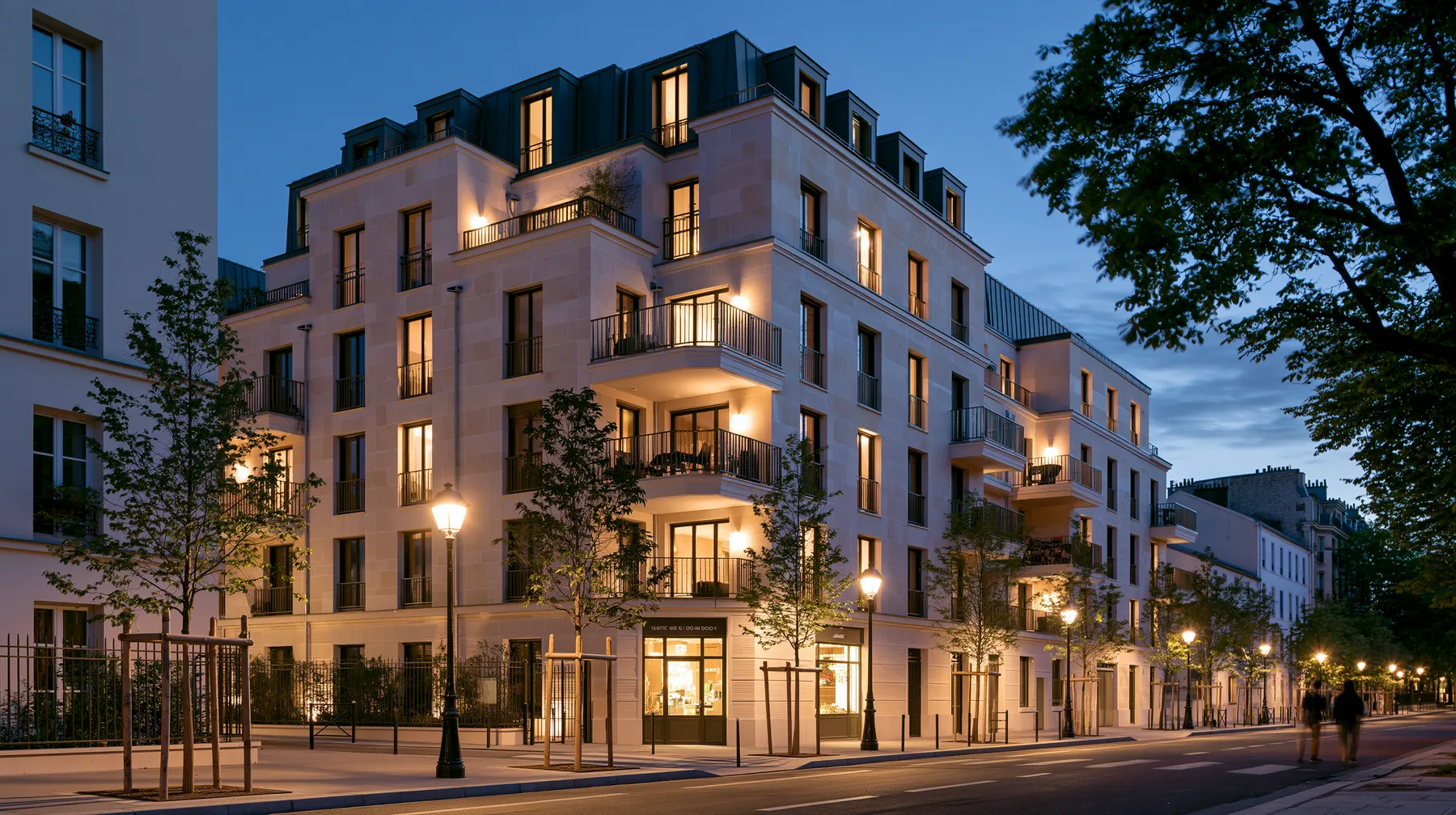
French Law No. 2025-541 of 16 June 2025 “to facilitate the conversion of offices and other buildings into housing” was published in the Official Journal (Journal officiel) on 17 June 2025. It has nine articles and has applied since 18 June 2025.
For an owner of, or investor in, an office building in Île-de-France, it addresses three obstacles: a local zoning plan (PLU, plan local d’urbanisme) that does not allow housing at that address, a building permit limited to a single use, and a co-ownership vote. It does not remove the need for any planning authorisation and says nothing about the building itself. This guide is based on the texts in force on 13 November 2026; one of them has been rewritten since the law was published.
Download version: Converting offices into housing: what the Law of 16 June 2025 changes (PDF, 5 pages, in French).
What does the Law of 16 June 2025 change, in three points?
The Law of 16 June 2025 changes three things for anyone wanting to convert offices into housing in France. It allows the use rules of the local zoning plan to be waived. It creates a building permit that authorises several successive uses. It sets the majority for the co-ownership vote.
- Waiver of the local zoning plan. The authority that issues the planning authorisation can allow a change to residential use, even where the plan does not permit it.
- The successive-use building permit. In designated areas, a single permit can authorise several uses that will follow one another in the building.
- Co-ownership. Where the conversion conflicts with the intended use of the building, it is voted on by the Article 24 majority.
Scroll the table sideways →
| Measure | What it allows | Its limit | Legal text |
|---|---|---|---|
| Waiver of the local zoning plan | Authorising a planning change of use to housing by waiving the plan’s use rules | A discretionary power, exercised case by case, subject to binding approval, which can be refused by a reasoned decision | Article L152-6-5 of the Town Planning Code |
| Successive-use building permit | Authorising, in a single permit, several successive uses of the building | Only in areas designated for this purpose; implementing decree awaited | Article L431-5 of the Town Planning Code |
| Co-ownership vote | Approving, by the Article 24 majority, the conversion of private units into residential premises | Only if the change conflicts with the intended use of the building; commercial premises excluded | Law No. 65-557 of 10 July 1965, Articles 9 and 24 |
The law contains other measures that this guide does not cover in detail. It opens the urban partnership project agreement (projet urbain partenarial) to conversion projects (Article L332-11-3 of the Town Planning Code). It provides for a buildability bonus for student residences (Article L151-28 of the same code).
In short: the Law of 16 June 2025 opens up three possibilities (a waiver of the local zoning plan, a successive-use permit and a co-ownership vote by the Article 24 majority). None is a vested right: each depends on a local decision or on the building’s circumstances.
The local zoning plan does not allow housing: can it be waived?
Yes, it is possible, but it is not a right. Under French law, the authority that issues the planning authorisation can allow conversion into housing by waiving the use rules of the local zoning plan. It decides case by case, after obtaining a binding approval (avis conforme), and can refuse by a reasoned decision.
The text is Article L152-6-5 of the Town Planning Code. It provides that “the authority competent to issue the planning authorisation may, when issuing such an authorisation, authorise the change of use of a building with a use other than housing into a building whose main use is housing, by waiving the rules on uses set by the local zoning plan or the document standing in its place”.
Who decides, and what does the waiver cover?
The decision lies with the authority that issues the planning authorisation. The word “may” (peut) makes it a discretionary power: it is exercised application by application, when the authorisation is issued, and the text does not require a prior council resolution. This authority “obtains the binding approval of the authority responsible for the local zoning plan”.
The waiver covers the rules on uses. It “also applies to extension or upward-extension works or construction covered by the planning authorisation”. The legal text cited does not refer to the plan’s other rules.
On what grounds can it be refused?
Refusal is possible and must be reasoned. The same article lists the grounds on which it may be based:
- the risk of nuisance for future occupants;
- insufficient access to the building by transport other than private cars;
- the project’s effect on school numbers, given the existing schools and those under construction;
- the project’s effect on social and functional mix objectives.
It therefore pays for an application to address these four points in advance: the building’s surroundings, its transport links, local schools and the project’s place in the neighbourhood.
An article rewritten in November 2025
Article L152-6-5 was rewritten by Law No. 2025-1129 of 26 November 2025. The version cited here has been in force since 28 November 2025. Summaries of the law published in 2025 are therefore out of date on this point: read the article in its current version before relying on it.
The law also allows the local zoning plan to designate areas where housing created by these conversions is “for use exclusively as a main residence” (Article L151-14-1 of the Town Planning Code). This is a question to put to the municipality before setting the brief.
In short: the waiver of the local zoning plan is requested with the planning application and decided building by building. It requires a binding approval and can be refused on grounds of nuisance, transport access, schools or social and functional mix. It can never be taken for granted.
What is a successive-use building permit?
It is a building permit that authorises, from the moment it is issued, several uses that will follow one another in the same building. It exists only in areas designated for this purpose. A decree is to set the conditions for applying it: in November 2026, it was still awaited.
The measure is in Article L431-5 of the Town Planning Code, created by the Law of 16 June 2025 and unchanged since. It does not apply everywhere: the authority responsible for the local zoning plan may “designate areas in which the building permit may authorise several successive uses of the building”. Without a designated area, there is no permit of this kind.
The text provides long-term protection: “Subsequent changes to the rules of the local zoning plan relating to uses have no effect on the validity of the permit issued, for a period of twenty years from the issue of the permit.” Where the change of use requires no authorisation, the owner informs the mayor “at least three months before the actual change of use”.
The article ends: “A decree issued after consulting the Council of State (décret en Conseil d’Etat) defines the conditions for applying this article.” The official implementation timetable announced this decree for December 2025. As of 13 November 2026, we had found no publication of it: it is still awaited. Two checks are essential before building a project on this permit: has the municipality designated an area, and has the decree been published?
In a co-owned building, what majority approves conversion to housing?
By the majority set in Article 24 of the French Law of 10 July 1965: a majority of the votes cast by the co-owners present, represented or voting by post. This vote only concerns a conversion that conflicts with the intended use of the building, and commercial premises are excluded.
The rule is in Law No. 65-557 of 10 July 1965, Articles 9 and 24: “Where changing the use of private units used other than as housing, with the exception of commercial premises, into residential premises conflicts with the intended use of the building, it is subject to the approval of the general meeting, which decides by the majority provided for in Article 24”. Any change to the allocation of service charges made necessary by this change is voted on by the same majority.
Three limits to bear in mind:
- the vote is only required if the change conflicts with the intended use of the building;
- commercial premises are not covered by this rule;
- works affecting the common parts follow their own voting rules.
In short: in a co-owned building, converting offices into housing is voted on by the Article 24 majority when the change conflicts with the intended use of the building. The rule applies neither to commercial premises nor to works on the common parts, which keep their own rules.
What does the law not change?
The law does not remove any authorisation. Under French law, converting offices into housing is still a planning change of use (changement de destination), subject to a prior declaration (déclaration préalable) or a building permit. The housing change of use regime (changement d’usage) does not apply in this direction: it only covers housing converted to another use.
Planning change of use: prior declaration or building permit
A planning change of use falls under the Town Planning Code. It requires a prior declaration (Article R*421-17 of the Town Planning Code), or a building permit when it involves works on the load-bearing structure or the façade (Article R*421-14 of the Town Planning Code). The waiver of the local zoning plan does not replace this procedure: it is granted as part of the authorisation.
Housing change of use: it does not apply in this direction
The housing change of use falls under another code. Under Article L631-7 of the Construction and Housing Code, “the change of use of residential premises may be made subject, by decision of the deliberative body, to prior authorisation”. The text covers residential premises converted to another use. Converting offices into housing is therefore not subject to it.
One consequence to be aware of before deciding: once they have become housing, the premises fall under this regime in the municipalities concerned. Switching back to another use later may then require an authorisation.
In Paris, according to the City of Paris information sheets, offices converted into housing can serve as compensation for a housing change of use. There is no official rate for this compensation.
Which taxes apply to a conversion in Île-de-France?
Two taxes need to be looked at: the annual tax on offices in Île-de-France (taxe annuelle sur les bureaux), from which vacant premises earmarked for conversion can be exempted, and the development tax (taxe d’aménagement), payable on the planning change of use unless an exemption is voted locally. These rules come not from the Law of 16 June 2025 but from the 2025 Finance Law.
The 2025 Finance Law is Law No. 2025-127 of 14 February 2025. The two regimes below derive from it. Confirm them with your tax adviser before any decision.
The annual tax on offices
Article 231 ter of the General Tax Code exempts premises “covered by a commitment to convert them into housing”, “where they are vacant on 1 January of the tax year”. The exemption requires three things:
- premises vacant on 1 January of the tax year;
- a prior declaration or building permit application that has been filed;
- a commitment to convert the premises into housing “within four years of the issue of the planning authorisation”.
If the commitment is not met, the tax becomes payable again, with a surcharge.
The development tax
The municipal or inter-municipal share of the development tax is payable on projects “which have the effect of changing the use of premises not intended for housing into residential premises” (Article 1635 quater B of the General Tax Code). Local authorities “may exempt” these premises by resolution (Article 1635 quater E of the General Tax Code). The answer therefore depends on what the municipality or the inter-municipal authority has voted. This point, too, should be confirmed with your tax adviser.
In short: in Île-de-France, vacant offices committed to a conversion can be exempted from the annual tax on offices, subject to conditions, including a commitment to convert them within four years. The development tax remains payable on the planning change of use, unless an exemption has been voted locally. Have both points confirmed by your tax adviser.
How much do office-to-residential conversion works cost?
A public report submitted in July 2025 puts the average cost of works at €2,550 excl. VAT per square metre of habitable floor area, across all housing types. The range runs from €2,050 to €4,500. These figures exclude land, and asbestos removal comes on top.
These figures come from the report “Transformation de bureaux en logements” (Converting offices into housing, in French) by Nadia Bouyer and Xavier Lépine, submitted to the French minister responsible for housing in July 2025 (page 37). The cost of works is “estimated at €2,550 excl. VAT/m² SHAB, across all housing types”; SHAB means habitable floor area (surface habitable). The estimate is based on a sample of projects by the Foncière de Transformation Immobilière.
Scroll the table sideways →
| Item | Cost of works, in euros excl. VAT per m² of habitable floor area |
|---|---|
| Average, all housing types | €2,550 |
| Average, family housing | €2,390 |
| Average, serviced residences | €3,050 |
| Range observed | €2,050 to €4,500 |
| Asbestos removal, on top | €50 to €600 |
These are published averages, taken from a sample of projects. They are not PRIMOE prices, and they say nothing about your building: every project needs its own estimate. Land is not included.
Law of 16 June 2025: questions office owners ask
Is the Law of 16 June 2025 on converting offices into housing in force?
Yes. French Law No. 2025-541 of 16 June 2025 was published in the Official Journal on 17 June 2025 and has applied since 18 June 2025. One point is still pending: to our knowledge, the decree setting the conditions for applying the successive-use building permit had not been published as of 13 November 2026.
The PLU does not allow housing at my address: am I entitled to a waiver?
No. The authority that issues the planning authorisation may grant the waiver; it is not obliged to. It obtains the binding approval of the authority responsible for the local zoning plan (PLU). It can refuse, by a reasoned decision, on the basis of nuisance for future occupants, access by transport other than private cars, schools, or social and functional mix objectives (Article L152-6-5 of the Town Planning Code).
Do you need a building permit to convert offices into housing?
Not always. Under French law, the conversion is a planning change of use: it requires a prior declaration, or a building permit when it involves works on the load-bearing structure or the façade. The Law of 16 June 2025 has removed neither procedure.
Do you need a housing change of use authorisation to go from offices to housing?
No. The housing change of use authorisation only covers residential premises converted to another use (Article L631-7 of the Construction and Housing Code). It does not apply to a change from offices to housing. However, once they have become housing, the premises fall under this regime in the municipalities concerned.
What majority is needed in a co-owned building to convert offices into housing?
When the conversion conflicts with the intended use of the building, it is put to the general meeting, which decides by the Article 24 majority: a majority of the votes cast by the co-owners present, represented or voting by post. Commercial premises are excluded from this rule, and works on the common parts follow their own rules.
Are empty offices in Île-de-France exempt from the annual tax on offices if they are to become housing?
They can be, subject to conditions: premises vacant on 1 January of the tax year, a prior declaration or permit application filed, and a commitment to convert them into housing within four years of the authorisation being issued. Otherwise, the tax becomes payable again with a surcharge. This rule comes from the 2025 Finance Law; confirm it with your tax adviser.
What does an office-to-residential conversion cost per square metre?
The report by Nadia Bouyer and Xavier Lépine, submitted in July 2025, puts the cost of works at an average of €2,550 excl. VAT per square metre of habitable floor area, within a range of €2,050 to €4,500, excluding land, with asbestos removal on top at €50 to €600 per square metre of habitable area. It is a published average from a sample of projects, not the price of your project.
What should you check in your building before relying on the law?
The law opens up possibilities; it does not tell you whether your building can become housing. Six checks come before anything is drawn: the planning rule at the address, the areas designated by the municipality, the co-ownership, the authorisation to apply for, the building itself and the tax position.
- The rule at your address. Does the local zoning plan allow housing? If not, the project depends on a waiver, and therefore on a case-by-case decision.
- Designated areas. Has the municipality designated areas where the new homes are reserved for main residences, or areas open to the successive-use permit?
- Co-ownership. Is the building held in co-ownership, and what do the co-ownership regulations (règlement de copropriété) say about the intended use of the building?
- The authorisation. Prior declaration or building permit: the answer depends on the works to the load-bearing structure and the façade.
- The building. Structure, floor heights and floorplate depth, fire safety: no law can make a building convertible if it does not lend itself to conversion.
- Tax. Annual tax on offices and development tax, to be confirmed by your tax adviser.
These checks are set out on our office-to-residential conversion page. They form the first step of a feasibility study, which establishes what the building can become before design and construction costs are committed. For an industrial or business building, see also our guide on converting an industrial building and our Development path. To submit a building to us: contact@primoe.fr.